
Why KYC-verified users still didn't buy — and how we closed the gap
Users who finished KYC had already cleared the hardest, highest-friction step — yet many still didn't make a first wine purchase within 7 days. I treated this not as a funnel leak but as a confidence problem: I built an opportunity tree to break the gap into specific user barriers, aligned design and engineering around the ones that mattered, and shipped a series of smaller, trust-building improvements instead of one large redesign. Product-side 7-day first-purchase conversion rose by nearly 10%.
- Role
- Product Manager (lead)
- Team
- 1 PM/designer · 2 engineers
- ≈10%
- 7-day first-purchase lift
- 6
- Improvements shipped
- 2
- Priority opportunity areas
The setup
AIFIAN's wine-investment product put KYC before the first purchase. Clearing KYC is a strong intent signal — it's the highest-friction step in the whole journey. So it was telling that a meaningful share of verified users still didn't buy anything within 7 days. The hard part was behind them; the purchase wasn't.
KYC completion, it turned out, wasn't enough. A verified user still had to work out what to buy, why it was worth it, whether the process could be trusted, and what would actually happen after paying.
The challenge
The drop-off was hard to attribute. It wasn't one broken screen or a single funnel leak — hesitation was spread across product discovery, product understanding, payment, resale expectations, and ownership. Jumping straight to "fix the checkout" would have been a guess.
Two concerns stood out as the heaviest:
- Risk. Wine investment was unfamiliar. Before spending real money, users wanted signals the platform was trustworthy: how long resale takes, whether other people had actually matched or resold, what happens if a credit-card payment status goes unclear, and whether the wine could ever be claimed or delivered.
- Choice. Even interested users often didn't know which wine to buy. Without help comparing and filtering, they stayed interested but undecided.
The core bet: treat first purchase as a confidence problem, not a funnel problem
Because the gap resisted single-cause attribution, I didn't start from a solution. I built an opportunity tree with one goal at the top — improve 7-day first-purchase conversion after KYC — and broke it into the user-facing reasons someone might not buy.
| User barrier | What it sounds like | Product direction |
|---|---|---|
| Doesn't know what to do post-KYC | "I'm verified… now what?" | Guide users back into the purchase journey |
| Can't choose a product | "Which wine?" | Filtering + clearer per-product value |
| Worried about risk | "Can I trust this? Can I resell?" | Make trust signals visible |
| Unsure about payment | "Did my card actually go through?" | Clearer payment status |
| Doesn't know what happens after buying | "…then what?" | Show resale history, matching time, ownership |
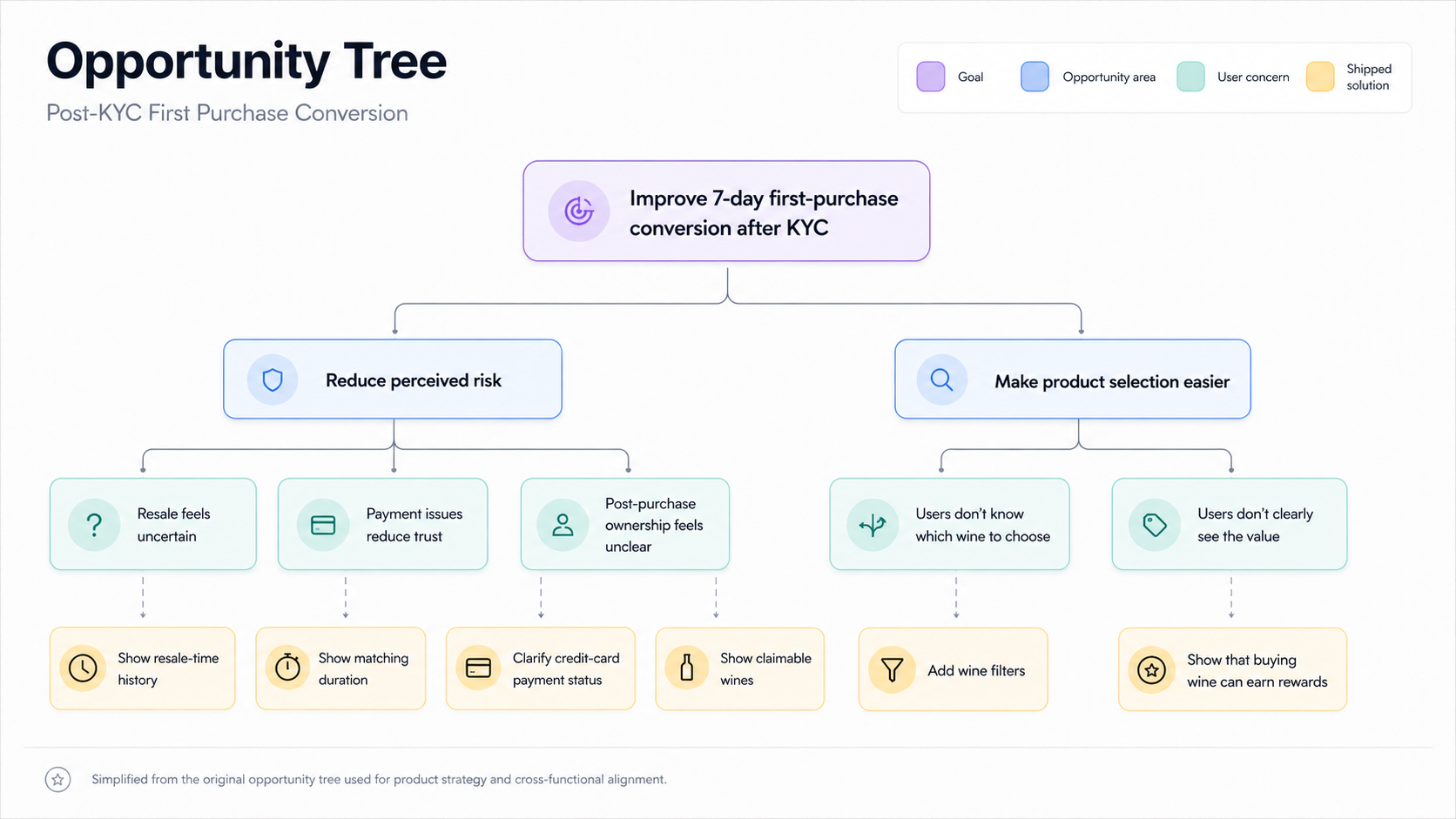
The product judgment calls
1 · Confidence over funnel. The easy framing was conversion-rate optimization — move the button, cut a step. The opportunity tree showed most barriers were about trust and clarity, not click-path friction. That changed what "fixing it" even meant.
2 · Many small interventions, not one big redesign. Because hesitation was distributed across the journey, I prioritized several targeted improvements in parallel — selection, resale expectations, payment clarity, ownership — rather than betting everything on a single rebuild. It kept momentum and let us learn from each change.
3 · Make invisible product mechanics visible. Several concerns came from users not being able to see what the product did. Resale and matching drive confidence, but if nobody can see how long matching usually takes or what has happened historically, the whole thing feels like a black box.
Make important product mechanics visible enough for users to trust the system.
4 · Ship what connects directly to a named hesitation. The tree produced more ideas than we could build. I prioritized the ones tied to a specific, observed user concern that could ship without a full product rebuild — so every change traced back to the same conversion goal.
How I prioritized
The tree produced more ideas than we could build, so I ran each through three filters:
- Tied to a named hesitation — it had to map to a specific, observed user concern.
- Shippable without a full rebuild — no dependency on re-architecting the journey.
- Likely to compound — it should help across many purchase decisions, not just one screen.
What shipped
Reducing risk and uncertainty
- Added historical records showing resale time, so users could see it wasn't open-ended.
- Surfaced how long matching had typically taken.
- Improved the interface when credit-card payment status ran into issues.
- Made it clearer which wines could be claimed or delivered.
Helping users choose
- Led the wine filtering feature as PM, so users could compare and narrow options.
- Shaped product communication that made it clearer buying wine could also earn rewards.
Together these moved users from "interested" to "comparing," and from "comparing" to a first purchase — while making the experience feel less like a black box.
What I owned
I drove this bottom-up as the PM:
- Framed the post-KYC drop-off as a confidence problem and built the opportunity tree.
- Prioritized the barriers and the improvements that addressed them.
- Translated each opportunity into product requirements and aligned design and engineering.
- Led the wine-filtering feature directly, and shaped reward and resale communication.
- Embedded the smaller fixes into larger in-flight projects, then tracked first-purchase signals.
Impact
How to read it. The ≈10% is a relative lift in 7-day first-purchase conversion among KYC-completed users, measured over roughly six months. Because first-purchase conversion is also moved by marketing, user quality, timing, and broader business conditions, I frame it as a product-side contribution, not a single-feature causal claim. The more durable win was a repeatable way to attack activation: stop treating conversion as one number, and break it into specific user barriers worth prioritizing.
What I took away
Activation problems are rarely one missing screen. Here, users had already done the hard thing — KYC — and still needed enough confidence to buy. That confidence lived in the details: product selection, payment clarity, resale expectations, ownership visibility, reward understanding.
It also taught me the reality of bottom-up product work. The opportunity tree wasn't a top-down mandate — it came from watching hesitation, connecting scattered issues, and reframing them into one activation problem. Many fixes weren't flashy, management-exciting features; they were small, foundational improvements that reduced uncertainty. So instead of pushing each as its own initiative, I broke them down and embedded them into larger projects that already had organizational momentum — resale transparency, payment clarity, claimable-wine visibility, filtering, reward communication — while tying every change back to the same conversion goal.
When a solution isn't obviously exciting on its own, the PM's job is to connect it to user behavior, business metrics, and existing strategic bets — so small improvements can compound into real impact.
Reach out to see more behind the workOut of respect for confidential client data, those details stay off the public site.
There's more behind this case: the real screens, dashboards, and the trade-offs that didn't make the write-up. I'll happily walk you through the real numbers and decisions in a conversation. Email me at